


My First
Rush Hour
-
This game was a spin-off of ThinkFun's popular Rush Hour game but made for preschoolers.
-
I designed this game to help children understand cause and effect and teach them about planning. I did this by turning all the puzzles into simple mazes.
-
We added color and shape matching later to give the game another teachable element that we quickly implemented and did not affect production costs.

Early Design
Process
-
I conceived and pitched 15 different concepts to Thinkfun during this time.
-
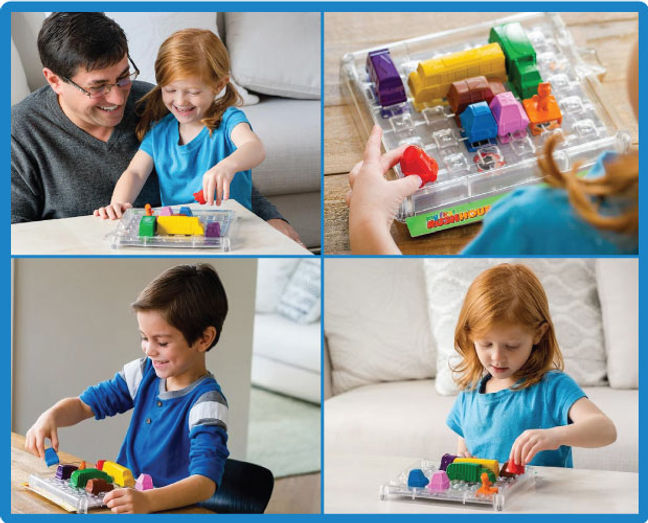
Though this game was for preschool-aged children, we knew they couldn't play it alone, so the gameplay needed elements for the child and their guardian to interact with together.
-
I designed the game to use the smaller Rush Hour branded cars at first, but to ensure ease of play and to strengthen fine motor skills, we decided that larger plastic vehicles better fit the vision of this game.

Balancing the Difficulty
-
Like the original Rush Hour games, the puzzles start super easy but gradually get more challenging, but when the intended player is only three years old, I needed to figure out what was too hard and what was too easy.
-
I balanced that out by simply increasing the number of turns the player’s car needed to make to finish the puzzle as they got harder.
-
The final few puzzles make players move other cars like in the original Rush Hour games.

The Final
Product
-
Thinkfun loved the game and immediately licensed the concept from us.
-
The small cards were replaced with giant, gameboard-sized cards so they could be easily handled and slid in underneath the clear board to help the preschoolers set up the gameboard all by themselves.
-
After a year of manufacturing and minor tweaks that I helped the ThinkFun team make, the final game was published on March 15, 2020.
Final Video


SPY
VISION
-
The game's goal is to arrest the three real spies, not the imposters, using a pair of glasses with polarized lenses.
-
The idea for this game came up entirely by accident, as I had bought two small polarized lens samples that were just sitting on my desk collecting dust. A few weeks later, I found an old prototype for a game way before my time that utilized red reveal technology. I had the idea to replace the red reveal with the polarized lenses. Spy Vision was born after a bunch of reworking and revisions to the original concept.

Reworking Old Games
-
Spy Vision was once a card game with red reveal glasses. The back of the cards had hidden symbols and words other players could read with the glasses.
-
Occasionally, I would go back through the company's portfolio, take old games, and freshen them up. Spy Vision was one of them.
-
The deduction and mystery elements were fun, but with no player interaction, the game just fell flat. I eliminated the card gameplay and turned it into a family board game to fix this.

Prototyping
& Gameplay
-
I cut out pieces of polarized film and attached them to glasses; then, I would turn the film 90 degrees and glue it onto a cardboard standee. When you looked through the glasses, the standee was pitch black, but without the glasses, you could see the artwork clearly.
-
I then found this gray film that looked identical to the polarized film and glued that to 3 other pairs of glasses. The 3 gray film glasses and the one polarized film glasses looked similar, which was necessary, so other players didn't know who had the spy glasses and who didn't.

Pitch Video
This video was used to pitch the concept to Goliath Games. This video eventually sold the idea to the internal design team at Goliath, and that is why the game was licensed.
The Final
Version
-
Once this game was licensed, it took about two years to come out. It was released on July 8th, 2022.
-
There were a few snags during production, mainly the difficulty of attaching polarized film to the cardboard standees in production. Goliath chose to use a thicker film, which was heavier and more challenging to attach to the pieces.
-
This version of Spy Vision still has all the heart and unique features the original design had. I am proud of how this game came together.

Final Video


The Circle
Puzzle
-
This puzzle starts like any other: You take large pieces and interlock them with one another to create an image.
-
Once that is finished, there are holes all over, in 3 different sizes: small, medium, and large.
-
You take the discs, place them into any hole that fits, and spin them to try and line up the artwork.
-
If the artwork doesn’t line up, just take the suction cup ring, pull the disc out, and try again!

What is a Puzzle?
-
When everything locked down, all of our clients were looking for puzzles.
-
Puzzles are so simple, yet what was something fresh and never done before that we could sell?
-
I had worked on a game where you placed sewer caps into holes and had to turn them to have them line up with the artwork, but what if it was a puzzle instead?
-
Every piece needed to be interesting, so it was essential to get the imagery right.

Making a Puzzle
-
It may look simple, but this was one of the most time-consuming prototypes I have ever worked on.
-
The artwork needed to be detailed enough to make every piece interesting, and there was no way to cut this by hand.
-
We found an image that checked all the boxes, but I had to recreate the artwork as a vector to get it as big as we needed.
-
I spent weeks laser-cutting this puzzle until it was perfect.

Pitch Video
Sometimes, the prototype does all the talking; in this case, a fully working and built-out prototype helps tremendously in selling this product.
The Final
Puzzle
-
This concept was snatched up quickly, a contract was offered and signed, and then, almost immediately, production started.
-
The suction cup was on the chopping block for a little while as it would bump the cost, but once playtesters started getting their hands on the prototypes, they quickly realized the suction cup was needed.
-
Initially, all the circle pieces were one size, but three different-sized circles were used to add some needed complexity.

Final Video


Think, Find, Smash!
-
This game concept started as a spinoff game for Trivia Pursuit. The player draws a card, and then all players race to find the answer on this giant, colorful board. The only problem is that trivia is hard...
-
We had many interested parties take this game in for testing, only for it to be dropped after playtesting as it was found too difficult for young and old players.
-
To fix that problem, my solution was to make all the trivia super easy.

Making Visual Trivia
-
To make easy trivia questions, I started with topics that anyone within the USA would know: colors of things, states, simple one-word answers, and true and false questions.
-
There was also a focus on reflexes. If everyone knows the answer, you must be the first to find and slap it.
-
Slapping the answer with your hand worked at first, but sneaky player found ways to cover large areas of the board, increasing their chances of getting the correct answer. That is when we switched to pointers.

Refinement & Testing
-
Once the Trivia Pursuit team passed on the game, we removed the brand and created a generic version to sell it to someone else potentially.
-
To mix up the gameplay each round, I cut the board into four pieces, each with images on the front and back. The front and back of each piece contained the same words and pictures, just in different places, so every time the game was set up, every image or phrase would be there, just not in the same place as last time.

Pitch Video
Even if the rules of a game are simple, if the video looks boring, people get bored watching it. A little extra love and time went into this video, making a huge difference.
The Final
Game
-
This was not a quick turnaround. From licensing to release date, this game took almost three years to come out, but it was worth it.
-
John Adams captured all the magic of our prototype and turned it into the exact game I had envisioned.
-
The silly and colorful art style perfectly matches the easy yet chaotic gameplay.
-
This game was released on July 18, 2023. With it still fresh on the market, I am excited to see how it is received.

Final Video


